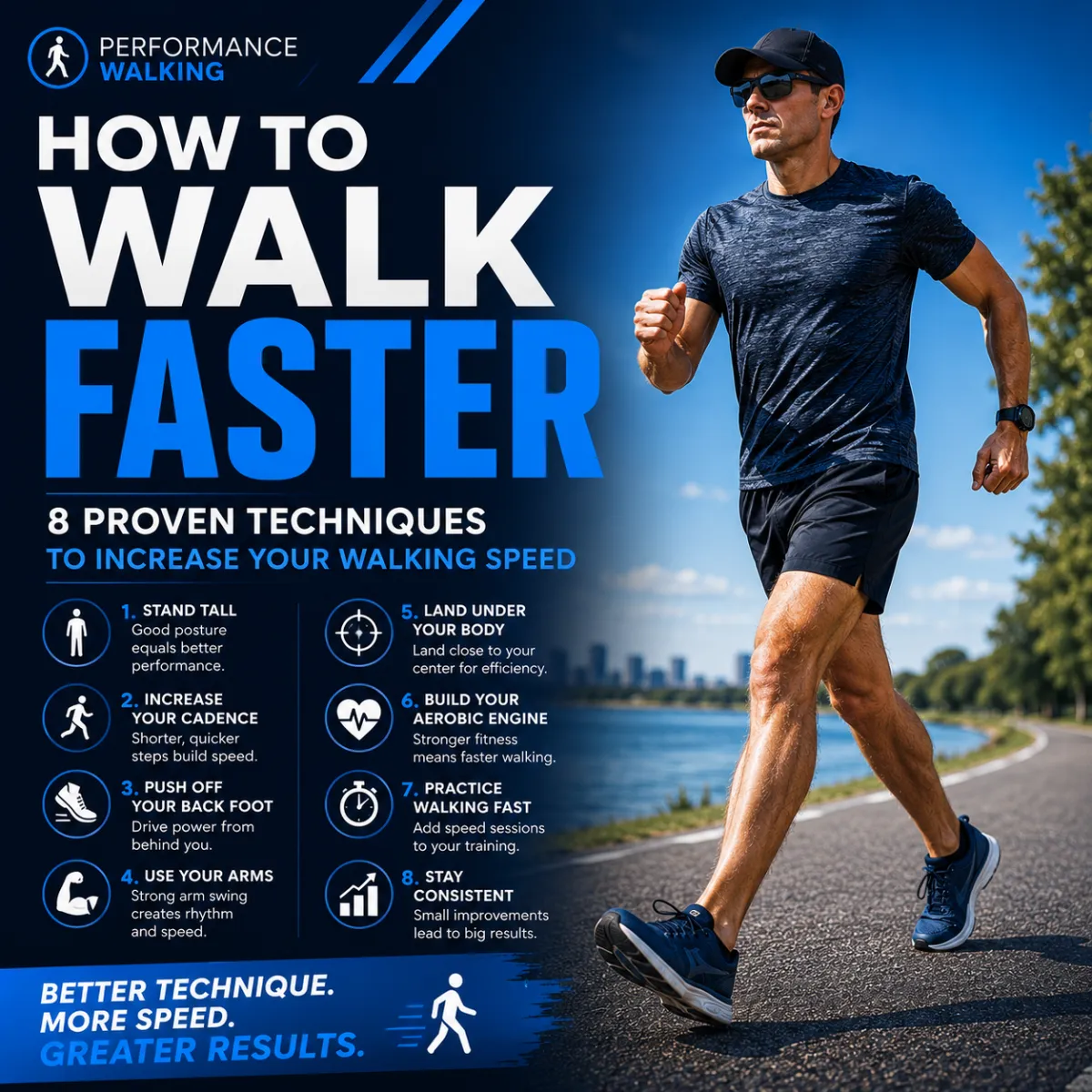
How to Walk Faster: 8 Proven Techniques to Increase Walking Speed
How to Walk Faster: 8 Proven Techniques to Increase Your Walking Speed
Category: Performance Walking
Reading Time: 5 minutes
Introduction
If you've ever wondered how some people seem to glide effortlessly down the trail while you're working hard just to keep up, the answer usually isn't genetics.
It's technique.
Walking faster isn't about taking huge steps or pushing yourself until you're exhausted. In fact, many beginners slow themselves down by trying too hard.
The fastest walkers use efficient movement, proper posture, and consistent training to improve their speed over time.
Whether your goal is to complete a faster 5K walk, prepare for a half marathon, improve your fitness, or simply enjoy walking at a quicker pace, these techniques will help you move faster while using less energy.
1. Stand Tall
Good posture is the foundation of fast walking.
Keep your head up and look 15 to 20 metres ahead rather than down at your feet.
Relax your shoulders, keep your chest open, and imagine a string gently pulling the top of your head upward.
When your posture improves, your breathing becomes easier and your stride becomes more efficient.
2. Increase Your Cadence
One of the biggest mistakes new walkers make is trying to take longer strides.
Instead, think about taking quicker, shorter steps.
A slightly faster cadence creates smoother movement and reduces the braking effect that comes from reaching too far in front of your body.
As your rhythm improves, your speed naturally increases.
3. Push Off Your Back Foot
Most of your power comes from behind you.
Rather than simply stepping forward, focus on pushing through your back leg and finishing each stride.
Imagine you're gently pushing the ground away behind you.
This small adjustment can noticeably improve your walking speed without making the effort feel much harder.
4. Use Your Arms
Your arms play a much bigger role than most people realize.
Bend your elbows to about 90 degrees and swing them naturally from your shoulders.
Avoid crossing your arms in front of your body.
Instead, drive them forward and backward.
A stronger arm swing helps create rhythm and encourages your legs to move faster.
5. Land Under Your Body
Efficient walkers land with their foot close to their centre of mass.
If your foot lands too far in front of you, it creates a braking effect that slows you down.
Focus on smooth, controlled steps underneath your hips rather than reaching forward.
You'll feel more balanced and move much more efficiently.
6. Build Your Aerobic Engine
Technique is important, but fitness matters too.
The stronger your aerobic system becomes, the easier it is to maintain faster walking speeds.
This is why Zone 2 walking is such an important part of performance walking.
By regularly training at an easy, sustainable effort, you'll gradually improve your endurance and be able to walk faster for longer without feeling exhausted.
Related Guide: Zone 2 Walking: The Secret to Better Endurance.
7. Include Speed Sessions
If your goal is to become a faster walker, you need to occasionally practice walking fast.
Try adding one or two performance walking sessions each week.
For example:
Warm up for 10 minutes.
Walk quickly for 3 to 5 minutes.
Recover with 2 minutes of easy walking.
Repeat 4 to 6 times.
Cool down for 10 minutes.
These sessions teach your body to become comfortable walking at higher speeds while maintaining good technique.
8. Stay Consistent
Perhaps the most overlooked factor in walking faster is consistency.
Walking speed doesn't improve overnight.
Small improvements made every week eventually become major improvements over months of training.
Aim to walk several times each week while gradually building your endurance, technique, and confidence.
Consistency will almost always outperform occasional hard workouts.
Common Mistakes
Avoid these common habits:
Taking steps that are too long.
Looking down instead of ahead.
Tensing your shoulders.
Forgetting to use your arms.
Walking too fast on every workout.
Ignoring recovery days.
Sometimes slowing down on easy days actually helps you become faster on your hard days.
Putting It All Together
Walking faster isn't about working harder.
It's about moving more efficiently.
By improving your posture, increasing your cadence, using your arms, building aerobic fitness, and practicing consistently, you'll become a stronger and faster walker over time.
Focus on mastering one technique at a time.
As these habits become natural, you'll notice your pace improving without feeling like you're working significantly harder.
Continue Learning
Want to become a better walker?
Continue with these Performance Guides:
Each guide builds on the previous one to help you develop better technique, improve endurance, recover smarter, and enjoy walking at a higher level.
Frequently Asked Questions
How long does it take to walk faster?
Most people notice improvements within four to eight weeks of consistent practice.
Should I take longer strides?
No. Shorter, quicker steps are usually more efficient than overstriding.
How often should I practice fast walking?
One or two dedicated speed-focused walking sessions each week are enough for most people.
Join the Performance Walking Club
Ready to unlock your full walking potential?
Inside the Performance Walking Club you'll get structured walking plans, technique coaching, Zone 2 workouts, speed sessions, monthly challenges, and a supportive community dedicated to helping you move better, walk faster, and go farther.
Train smarter. Recover better. Walk farther.
