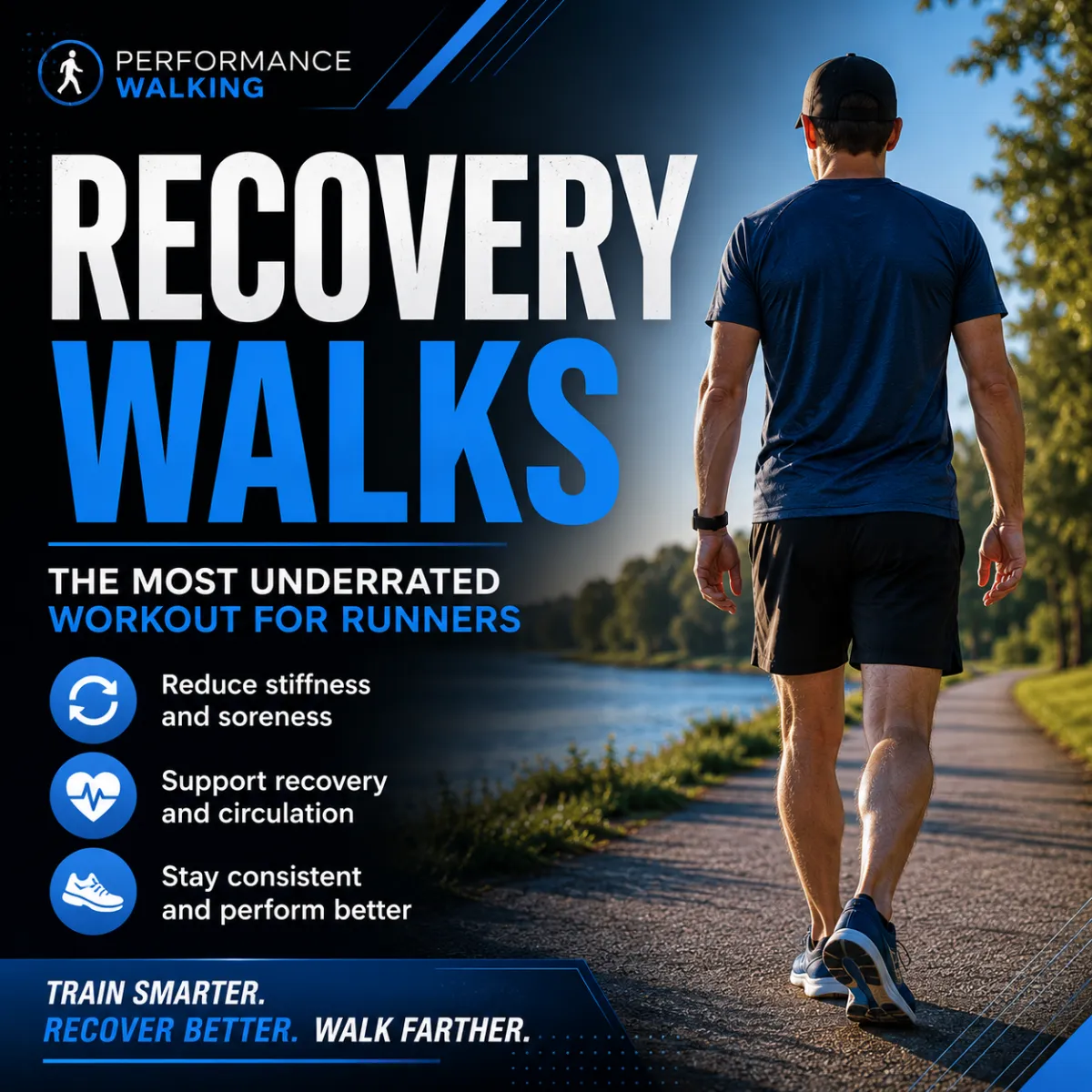
Recovery Walks for Runners: The Most Underrated Workout
Recovery Walks: The Most Underrated Workout for Runners
Category: Recovery Walks
Reading Time: 4–5 minutes
Recovery Is Where Progress Happens
Most runners spend their time thinking about the next workout.
The next long run.
The next speed session.
The next race.
Very few spend the same amount of time thinking about recovery.
Yet recovery is where your body actually becomes stronger. Every hard workout creates stress. During recovery, your muscles repair, your energy stores are restored, and your body adapts so you're ready for the next challenge.
Without enough recovery, fatigue begins to build. Your legs feel heavy, motivation drops, and small aches can gradually become injuries.
That's why recovery isn't something that takes you away from training.
Recovery is part of training.
One of the simplest ways to support that process is with a recovery walk.
What Is a Recovery Walk?
A recovery walk is a purposeful, low-intensity walk performed after a hard workout, a long run, or on a scheduled recovery day.
Unlike a performance walk or a speed workout, the goal isn't to push yourself.
The goal is to help your body recover while staying active.
Instead of sitting on the couch all day, you're encouraging gentle movement that helps you feel refreshed and ready for your next quality training session.
Think of it as active recovery rather than another workout.
Why Recovery Walks Work
Recovery walks are simple, but they're surprisingly effective.
Some of the benefits include:
Helping reduce stiffness after hard workouts.
Keeping your body moving without additional running impact.
Supporting healthy circulation through gentle activity.
Maintaining your daily movement routine.
Helping you feel physically and mentally refreshed.
Perhaps the biggest benefit is consistency.
Many runners believe every workout needs to be hard. In reality, your body responds to the total amount of stress you accumulate over weeks and months. Recovery walks allow you to keep moving while giving your body the opportunity to absorb the training you've already completed.
How I Like to Use Recovery Walks
One thing I've learned through my own training is that not every day should feel the same.
Some days are designed to challenge your body.
Other days are designed to prepare your body for the next challenge.
That's exactly how I view recovery walks.
After a demanding training session, I don't feel the need to prove my fitness again the following day. Instead, I'll head out for an easy walk, enjoy the movement, loosen up my legs, and let my body recover.
Ironically, those easier days often leave me feeling much stronger for my next workout than trying to squeeze in another run.
Recovery walking isn't about doing less.
It's about making better decisions so you can train consistently over the long term.
How to Do a Recovery Walk
Recovery walks don't need to be complicated.
Here's a simple guideline:
Walk for 20–45 minutes.
Maintain a relaxed, conversational pace.
Focus on comfortable movement rather than speed.
Finish feeling better than when you started.
If you're checking your pace every few minutes or breathing hard, slow down.
Recovery comes first.
When Should You Recovery Walk?
Recovery walks fit naturally into almost any training plan.
Good opportunities include:
The day after a long run.
Following an interval or hill workout.
During recovery weeks.
On busy or stressful weeks when your body needs a lighter training load.
When your legs feel tired but still benefit from gentle movement.
Remember, recovery walks don't replace every easy run.
They're simply another tool that helps you stay healthy and consistent.
Common Mistakes
The biggest mistake runners make is walking too fast.
Recovery isn't another race.
The second mistake is skipping recovery altogether because it doesn't feel productive.
The truth is, many of your biggest improvements happen because you recovered well enough to complete your next hard workout with quality.
Finally, don't compare your recovery walk to your running pace.
They have completely different purposes.
Judge your recovery walk by one simple question:
Do I feel better afterward?
If the answer is yes, you're doing it right.
Continue Your Performance Walking Journey
Recovery walking is just one part of a smarter training strategy.
Continue learning with these Performance Guides:
Together, these guides will help you understand how performance walking improves endurance, supports recovery, and helps you stay active for years to come.
Frequently Asked Questions
How long should a recovery walk be?
Most runners benefit from 20 to 45 minutes at an easy, conversational pace.
Can I recovery walk instead of an easy run?
Absolutely. On days when you're feeling fatigued or recovering from a hard workout, a recovery walk can be an excellent alternative.
Should recovery walks feel easy?
Yes. You should finish feeling refreshed—not exhausted.
Join the Performance Walking Club
If you're ready to train smarter, the Performance Walking Club gives you the tools to put these strategies into practice.
Inside you'll find structured walking plans, Zone 2 workouts, recovery sessions, monthly challenges, expert coaching, and a community of walkers and runners committed to improving together.
Train smarter. Recover better. Walk farther.
