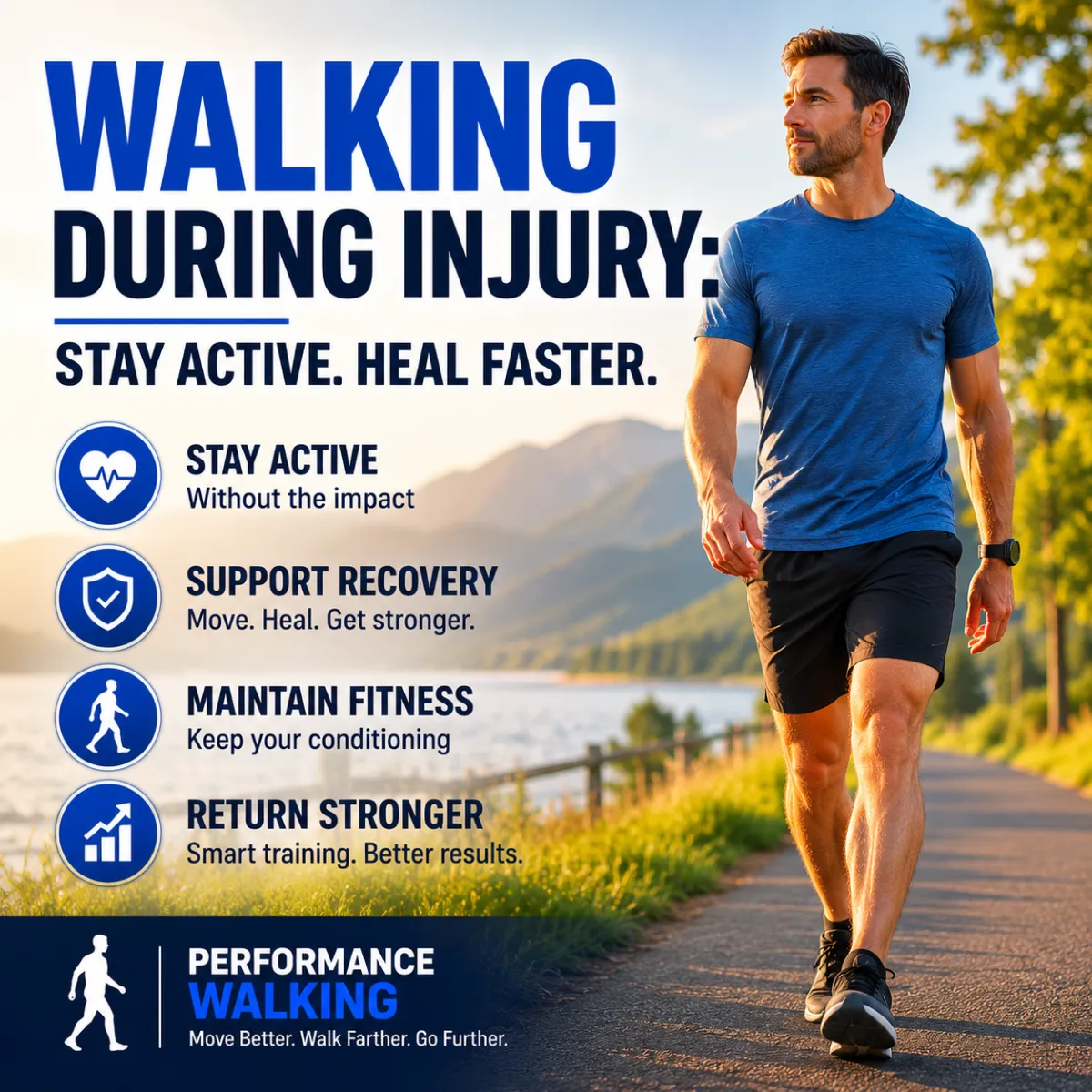
Walking During Injury: Stay Active, Heal Faster
Walking During Injury: Stay Active, Heal Faster
Category: Injury Prevention
Reading Time: 7–9 minutes
Injured Doesn't Have to Mean Inactive
For many runners, injury feels like the end of training.
The first instinct is often to stop moving altogether until the pain disappears.
In some situations, complete rest is necessary. But for many common overuse injuries, controlled movement can actually become part of the recovery process.
That's where performance walking can play an important role.
Rather than losing weeks of fitness, many runners can maintain aerobic conditioning while reducing the impact that caused the injury in the first place.
If you're new to performance walking, start by reading Why Every Runner Should Walk More. It explains why walking isn't a step backward—it's a smart part of long-term training.
Why Running Injuries Happen
Most running injuries don't happen overnight.
They build gradually through repeated stress that exceeds the body's ability to recover.
Common examples include:
Shin splints
Runner's knee
Plantar fasciitis
Achilles tendon irritation
IT band syndrome
Often, the solution isn't doing nothing.
It's reducing the stress while continuing to move appropriately.
Why Walking Can Help
Performance walking provides many of the benefits of exercise while placing much less impact on your body.
Walking may help you:
Maintain aerobic fitness
Increase circulation
Reduce stiffness
Improve mobility
Stay mentally engaged with training
Movement is often better than complete inactivity when it can be done comfortably and within the guidance of your healthcare provider.
Listen to Pain, Not Pride
Walking should never increase your pain.
A simple guideline is:
Pain during walking should stay mild.
Pain should not worsen as you continue.
Symptoms should not be significantly worse the following day.
If they are, reduce the duration or intensity and consult a qualified healthcare professional.
A Simple Recovery Walk
Here's an easy starting point:
5-minute easy warm-up
20–30 minutes of comfortable walking
Gentle mobility afterward
Focus on relaxed movement instead of speed.
Your goal is recovery, not performance.
When You Shouldn't Walk
There are situations where walking may not be appropriate, including:
Suspected fractures
Acute ligament injuries
Severe swelling
Significant pain with weight bearing
Injuries where your healthcare provider has advised complete rest
Always follow the guidance of your physician or physiotherapist.
Recovery Is Still Training
One of the biggest mistakes athletes make is believing that progress only happens during hard workouts.
Recovery is part of training.
Smart athletes adjust their training rather than abandoning it.
Walking can help you maintain momentum while giving your body time to heal.
Continue Learning
Once you're feeling better, read Zone 2 Walking: The Secret to Better Endurance to learn how low-intensity walking can help you rebuild fitness safely.
If you haven't already, start with Why Every Runner Should Walk More to understand how performance walking supports long-term performance.
Join the Performance Walking Club
Inside the Performance Walking Club you'll receive:
Structured walking plans
Recovery-focused workouts
Monthly walking challenges
Expert coaching
A supportive community of walkers and runners
Recover smarter.
Move with confidence.
Keep making progress.
