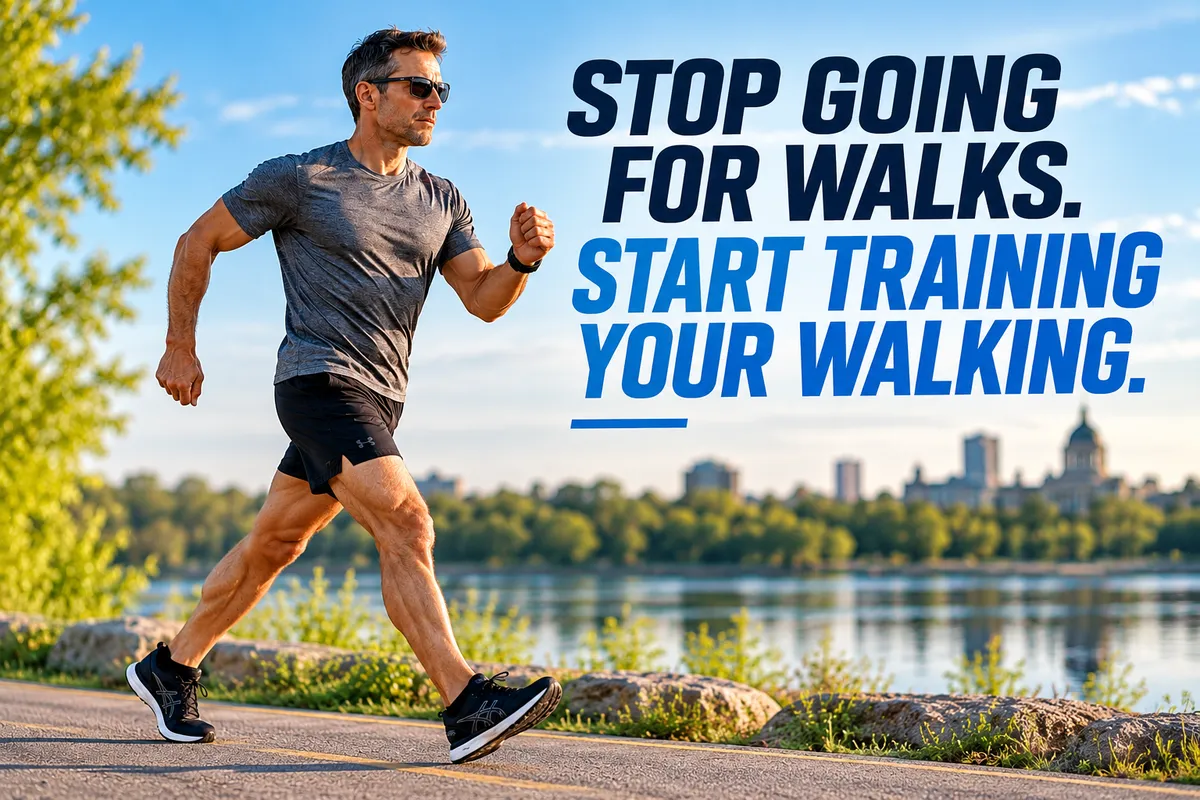
Stop Going for Walks. Start Training Your Walking.
Stop Going for Walks. Start Training Your Walking.
Most of us have been walking for almost our entire lives.
We walk the dog.
We walk around the neighbourhood.
We walk through the grocery store.
We track our steps.
And increasingly, we go for walks because we know walking is one of the simplest things we can do for our health.
There's absolutely nothing wrong with any of that.
But there's a question almost nobody asks:
What if you actually trained your walking?
Not just walked more.
Not just tried to hit 10,000 steps.
Not just went for a longer walk on the weekend.
What if you deliberately trained yourself to become a better walker?
Faster.
Stronger.
More efficient.
Capable of covering greater distances.
Capable of maintaining a faster pace.
Capable of walking a 5K faster than you ever thought possible.
That's where Performance Walking begins.
Walking Is an Activity. Performance Walking Is Something You Train.
Think about almost any other physical activity.
If someone wants to become a better runner, they don't simply run the exact same distance at the exact same pace every day.
They train.
They might have easy sessions, intervals, longer endurance sessions and faster efforts. They work on strength. They recover. They gradually increase what their body is capable of doing.
Cyclists do the same thing.
Swimmers do it.
Rowers do it.
Strength athletes do it.
But walking is often treated differently.
We tend to think the only variable that matters is how much of it we do.
How many steps did I get today?
How long did I walk?
Did I get my 30 minutes?
Those can all be useful measures.
But they don't tell us something much more interesting:
How good are you at walking?
How Fast Could You Walk?
That's the question that fascinates me.
Most people know approximately how many steps they take.
Some know how far they regularly walk.
But ask someone:
“What's the fastest pace you can sustain while still walking?”
Most people have absolutely no idea.
And why would they?
They've probably never tested it.
Imagine walking a timed 5K today.
Then imagine spending eight weeks deliberately training your walking.
You work on your technique.
You develop your endurance.
You introduce faster walking intervals.
You improve your strength.
You learn how to pace yourself.
Then you walk that same 5K again.
What might happen?
Could you take a minute off your time?
Three minutes?
Five?
Could a pace that initially felt difficult eventually become comfortable?
That's what happens when we stop looking at walking solely as an activity and begin looking at it as a trainable skill.
You Don't Have to Become a Runner
This is an important distinction.
Performance Walking isn't about eventually graduating to running.
Walking isn't the beginner version of running.
It's its own form of movement.
You can pursue greater speed, endurance and physical capacity while remaining a walker.
Nor do you have to become a traditional competitive racewalker.
Racewalking is an established sport with specific techniques and competition rules.
Performance Walking occupies a different space.
It's for someone who wants to discover what happens when they take the movement they already know—walking—and begin deliberately improving it.
Maybe you want to walk your first strong 5K.
Maybe you want to complete a 10K.
Maybe you already walk regularly and want a new challenge.
Maybe running doesn't appeal to you.
Maybe you simply want to know:
How fast could I become?
Those are all perfectly legitimate reasons to train your walking.
Speed Isn't Just About Trying Harder
If you've ever tried to walk considerably faster than normal, you've probably experienced this.
You start reaching farther with every step.
Your shoulders tense.
Your arms start flying.
Everything feels harder.
And eventually you slow down.
Performance Walking isn't simply regular walking performed with more effort.
There are skills involved.
Posture matters.
Cadence matters.
How your foot lands relative to your body matters.
How you use your arms matters.
How effectively you propel yourself forward matters.
And as those things improve, walking faster can begin to feel more natural.
That's one of the things I find most exciting about Performance Walking.
There's something to learn.
Your Walking Can Have Workouts
Once we accept that walking can be trained, another possibility opens up.
Not every walk has to accomplish the same thing.
You can have an easy walk.
You can have a longer endurance walk.
You can have a faster tempo session.
You can perform walking intervals.
You can train hills.
You can practice technique.
You can strength train to support your walking.
And importantly, you can recover.
Suddenly you're no longer simply accumulating kilometres.
You're building something.
Each session can have a purpose.
Give Yourself Something to Train For
This might be the piece that's been missing for a lot of walkers.
Runners have races.
Cyclists have events.
Triathletes have competitions.
And those events give their training direction.
Walkers deserve that too.
Imagine having a date on the calendar and knowing:
Eight weeks from now, I'm walking a timed 5K.
Suddenly Tuesday's walk has meaning.
That interval session has meaning.
Your strength work has meaning.
You can establish a baseline, train, show up on event day and discover what changed.
You don't have to win anything.
The person you're competing against might simply be the person you were eight weeks ago.
That's still performance.
Walking Can Be More Than Steps
I want to be clear about something.
There is nothing wrong with going for a leisurely walk.
There is nothing wrong with walking for relaxation, conversation, mental health or simply because you enjoy being outside.
And if tracking your daily steps gets you moving more, that's fantastic.
Performance Walking doesn't replace any of that.
It adds another possibility.
Walking can be recreation.
Walking can support health.
Walking can be transportation.
And walking can also be something you train.
You can become better at it.
You can measure your progress.
You can challenge yourself.
You can discover capabilities you didn't know you had.
And perhaps that's the most interesting part of all.
Most of us learned to walk before we can even remember.
But that doesn't mean we've discovered how well we're capable of doing it.
So the next time you lace up your shoes, consider asking yourself a different question.
Not:
How many steps do I need today?
But:
How Fast Could I Walk?
You might be surprised by the answer.
Ready to Start Performance Walking?
If this way of thinking about walking sounds interesting, start with the free Performance Walking Starter Guide.
You'll learn the fundamentals of Performance Walking and how to begin developing your technique, speed and endurance.
Already have the guide and ready to start training?
Inside the Performance Walking Club, you'll find structured training programs, technique guidance and support to help you become a faster, stronger and more capable walker.
Membership is $19/month.
